Laser Cutting vs. CNC Machining: Which Process Fits Your Part?
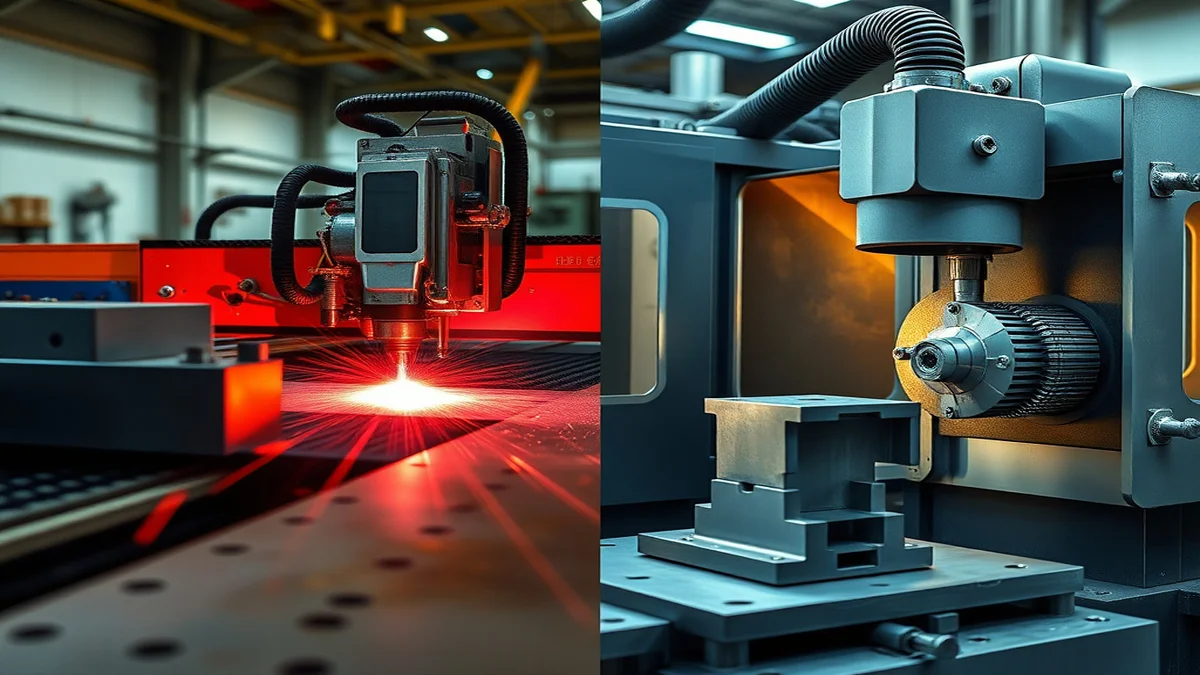
Laser cutting and CNC machining come up together constantly in fabrication conversations, and buyers new to sourcing custom metal parts sometimes treat them as competing options for the same job. In practice, they solve different problems, and a lot of parts use both — a laser-cut blank that then gets machined for the features cutting alone can't produce.
What Each Process Is Actually Good At
Laser cutting is fundamentally a two-dimensional process: it traces a programmed path through flat stock, producing profiles, cutouts, and hole patterns efficiently and without hard tooling. It's the default first step for most brackets, panels, and enclosure blanks, whether the finished part stays flat or goes on to bending and welding.
CNC machining removes material from solid stock — or from an existing blank — along a multi-axis toolpath, and is the process that produces true 3D geometry: precision bores, threaded holes, counterbores, and features held to a tolerance tighter than cutting or forming alone can achieve. If a feature has to fit precisely against a mating part, machining is usually how that precision gets there.
The Tolerance Question
This is the single biggest factor in deciding between the two, or deciding to use both. Laser cutting holds a solid general tolerance appropriate to material thickness, which is more than adequate for the large majority of bracket, panel, and structural features. But it doesn't produce a threaded hole, and it can't consistently hold the tight, specific tolerance that a precision bore or a critical mating face needs — that's squarely CNC machining territory.
A useful rule of thumb: if a dimension needs to be "close," laser cutting or forming is probably fine. If a dimension needs to be "exact" for something else to fit onto it, that feature likely needs to be machined.
Cost: Which Is Cheaper Depends on the Geometry
For flat, two-dimensional profile work, laser cutting is almost always more cost-effective than machining the same shape from solid stock — machining a flat profile from solid removes far more material and takes far more machine time than cutting it from sheet stock directly. But for a part that genuinely needs 3D geometry, threaded features, or tight-tolerance precision, trying to force that into a cutting-only process either isn't possible or requires a workaround that ends up costing more than just machining the feature properly in the first place.
When Parts Use Both Processes Together
This is more common than either process being used alone, especially on functional (not purely structural) parts. A typical combined sequence: a flat blank is laser cut to its developed profile — including all the non-critical holes and cutouts that don't need tight tolerance — and then loaded onto a CNC machine for the specific features that do: a precision bore, a tapped hole, a machined mounting face.
- Laser cut the flat profile and any general-tolerance holes efficiently from sheet or plate stock
- CNC machine the specific features that need tight tolerance — bores, threads, mating faces
- This combination is usually cheaper than machining the entire part from solid stock
- It also tends to be faster, since the bulk-material-removal step (cutting) is quicker than the precision step (machining) for the portion that doesn't need precision
How to Decide for Your Part
Look at your drawing feature by feature rather than trying to categorize the whole part as one process or the other. Flat profile, cutouts, and general-tolerance holes point to laser cutting. Any bore, thread, or feature with a tight tolerance callout points to machining. If your part has both kinds of features — which is common — it's very likely a combined-process part, and that's a normal, cost-effective way to build it, not a complication to avoid.
If you're not sure how to break your part down, send the drawing and describe what the part needs to do functionally. A shop that runs both processes in-house can map the feature breakdown for you and quote the combined sequence as one connected part flow, rather than making you guess at the split yourself.
Frequently Asked Questions
Technically yes, but not efficiently — machining a flat profile from solid stock removes far more material and takes far more time than laser cutting the same shape from sheet stock. For flat, two-dimensional geometry, laser cutting is almost always the more cost-effective choice.
Generally no — a precision bore meant to hold a bearing or another tight-tolerance mating component typically needs CNC machining to hold the required tolerance consistently. A laser-cut hole is a good fit for a clearance hole or a non-critical feature, but not for a precision fit.
Not necessarily — combining laser cutting for the bulk profile and machining for specific precision features is often cheaper than machining the entire part from solid stock, since the bulk material removal happens faster and cheaper via cutting. It's usually the most cost-effective path for a part that genuinely needs both general and precision features.
Have a part you're trying to source?
Send your drawing, material, and quantity and we'll confirm the right process before anything is quoted.